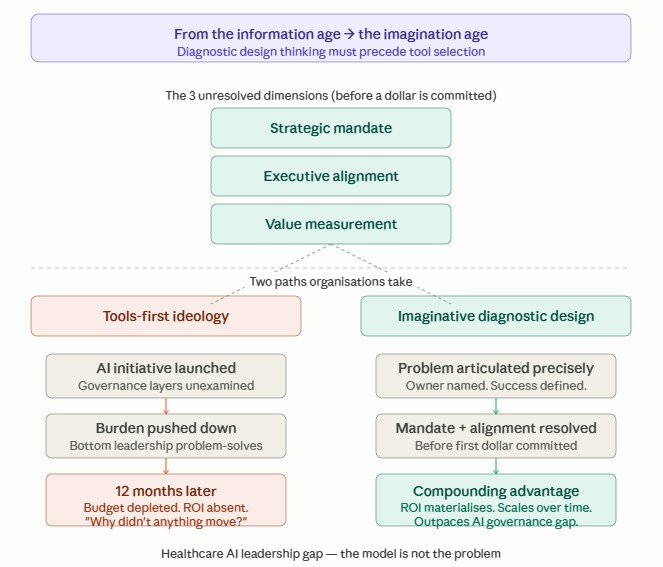
Hybrid Intelligence: Organizational and Strategic Biases
Why the human side of the human and machine partnership decides whether healthcare digital transformation succeeds
1. What Hybrid Intelligence Actually Means
The most consequential idea in enterprise AI is not a model. It is a partnership. Dellermann et al. (2019) define hybrid intelligence as the ability to achieve complex goals by combining human and artificial intelligence, producing results superior to what either could accomplish alone, with both sides continuously improving through mutual learning. Furthermore, three words in Dellermann et al.’s (2019) definition carry the strategic weight: collectively, superior, and continuously. The work is performed together; the outcome must exceed what each agent achieves separately; and the system is judged not only on its output but also on whether the human and the machine are both getting better over time.
A multidisciplinary research agenda has since formalized the ambition to design AI and augment human intellect collaboratively, adaptively, responsibly, and explainably, rather than to replace it (Akata et al., 2020).
The hybrid intelligence is fundamentally different from automation. Automation asks what the machine can take off our hands. Hybrid intelligence asks what the combined system can do that neither party could do before: the machine contributing scale, pattern recognition, and predictive consistency; the human contributing context, ethical reasoning, ambiguity tolerance, and accountability. In healthcare, where the cost of error is measured in lives and trust, the human half is not a transitional inconvenience awaiting better models. It is a permanent architectural component.
2. How Hybrid Intelligence Should Be Strategized
Because hybrid intelligence is a sociotechnical system rather than a technology purchase, the strategy must be designed around the partnership, not the procurement. Four principles were suggested to follow.
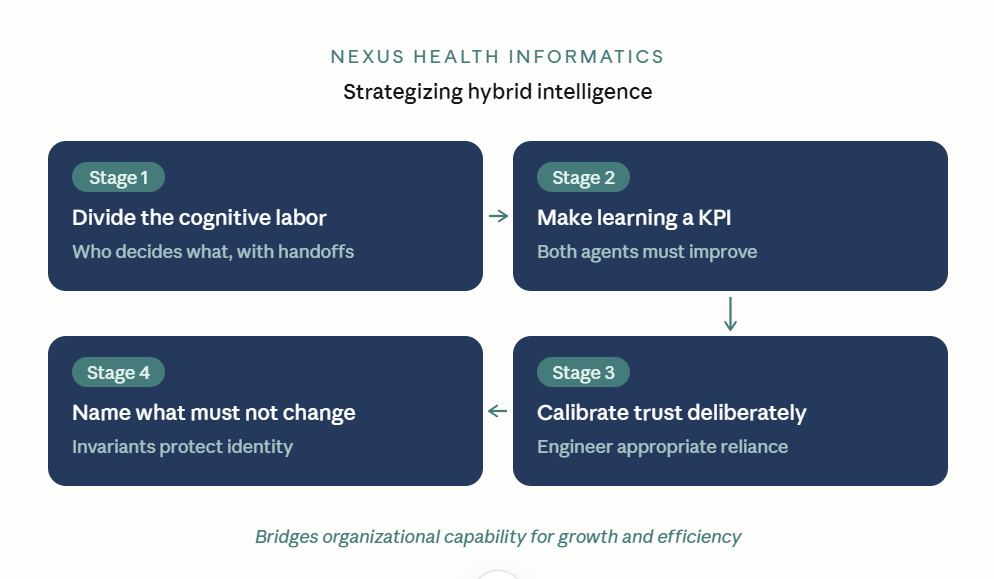
- Principle 1: Strategic imperative on the division of cognitive labor, not the tool. The central design question is which decisions the machine makes, which the human makes, and which they make together, with explicit handoff criteria. A deployment that never answers this question has not adopted hybrid intelligence; it has installed software.
- Principle 2: Treat learning as a key performance indicator (KPI). By definition, a hybrid system must improve both agents. If clinicians are not measurably sharper, and models are not measurably better calibrated, after a year of operation, the system is decaying toward either full automation or full rejection. Both endpoints dissolve the partnership.
- Principle 3: Calibrate trust deliberately. A comprehensive review of 20 years of empirical research shows that human trust in AI develops differently from trust in people, shaped by the system’s tangibility, transparency, reliability, and immediacy (Glikson & Woolley, 2020). Users over rely on systems they should question, a pattern documented extensively in clinical decision support, where automation bias produces both errors of commission and errors of omission (Abdelwanis et al., 2024), and they abandon systems they should trust after visible errors (Burton, Stein, & Jensen, 2020). Trust calibration, including when the AI should explain itself, when it should stay silent, and when it should escalate, is a design discipline, not an emergent property.
- Principle 4: Decide what must not change. AI without a strategy is expensive automation. The most valuable strategic act before scaling hybrid intelligence is naming the invariants, including clinical judgment as final authority, equity as a standing requirement, and privacy as architecture, so the partnership accelerates the organization without dissolving its identity.
3. The Leadership Biases That Will Hinder Execution
The biases most likely to derail a hybrid intelligence strategy sit in the executive suite, long before any model runs. Behavioral science gives them names, and leaders who cannot name them cannot govern them. A recent systematic review confirms that these cognitive biases remain pervasive in strategic decision-making, particularly in times of change (Acciarini et al., 2021).
Optimism bias and the planning fallacy. Executives systematically overestimate benefits and underestimate costs, timelines, and integration burden, a pattern documented across decades of strategic decision research and reconfirmed in recent reviews (Acciarini et al., 2021). In hybrid intelligence programs, this manifests as treating a pilot in one well-resourced unit as proof of enterprise readiness and budgeting for the model while ignoring the workflow redesign, training, and trust-building that account for most of the real cost.
Status quo bias. The preference for the current state, independent of its merits, is among the most robust findings in decision research (Samuelson & Zeckhauser, 1988). It produces the quiet failure mode of bolting AI onto unchanged workflows, which automates existing dysfunction at scale rather than redesigning the division of labor the partnership requires.
Overconfidence and the illusion of readiness. Leaders anchor on their organization’s past technology successes and conclude that AI is one more rollout. Hybrid intelligence is not a rollout; it is a renegotiation of how decisions get made. Overconfidence here shows up as governance theater: a committee exists, but no one holds veto power, owns model performance, or audits the human side of the partnership.
Confirmation bias at the portfolio level. Once leadership publicly commits to an AI narrative, evidence is curated to fit it. Successful use cases are amplified, quiet failures are reclassified as learnings, and dissenting clinical voices are read as resistance to change rather than as a signal. Kahneman (2011) reminds us that the confidence we feel in a judgment reflects the coherence of the story we have built, not the quality of the evidence beneath it.
Authority and vendor bias. When evidence of effectiveness comes primarily from the party selling the system, evaluation criteria are preselected. Leadership teams without independent informatics literacy delegate their skepticism to the vendor, which is not delegation but abdication.
Sunk cost escalation. After significant investment, leaders escalate commitment to failing deployments because stopping feels like a waste. In hybrid systems, this is doubly costly: the organization keeps a poor machine partner and simultaneously erodes the human partner’s trust for every future deployment.
Complacency and the deskilling blind spot. The subtlest executive bias is assuming the human safeguard remains constant while the machine improves. In reality, skills atrophy when routine cases are absorbed by the system, leaving humans weakest precisely where the AI fails. A hybrid strategy that does not invest in sustaining human expertise is quietly converting itself into an automation strategy without ever making that decision.
The common thread: these are not character flaws but predictable features of executive cognition. The remedy is structural, including premortems, independent challenge roles, decision audits, and governance bodies with genuine authority, rather than exhortations to be objective (Acciarini et al., 2021).
4. Organizational Culture: The Landscape Hybrid Intelligence Must Cross
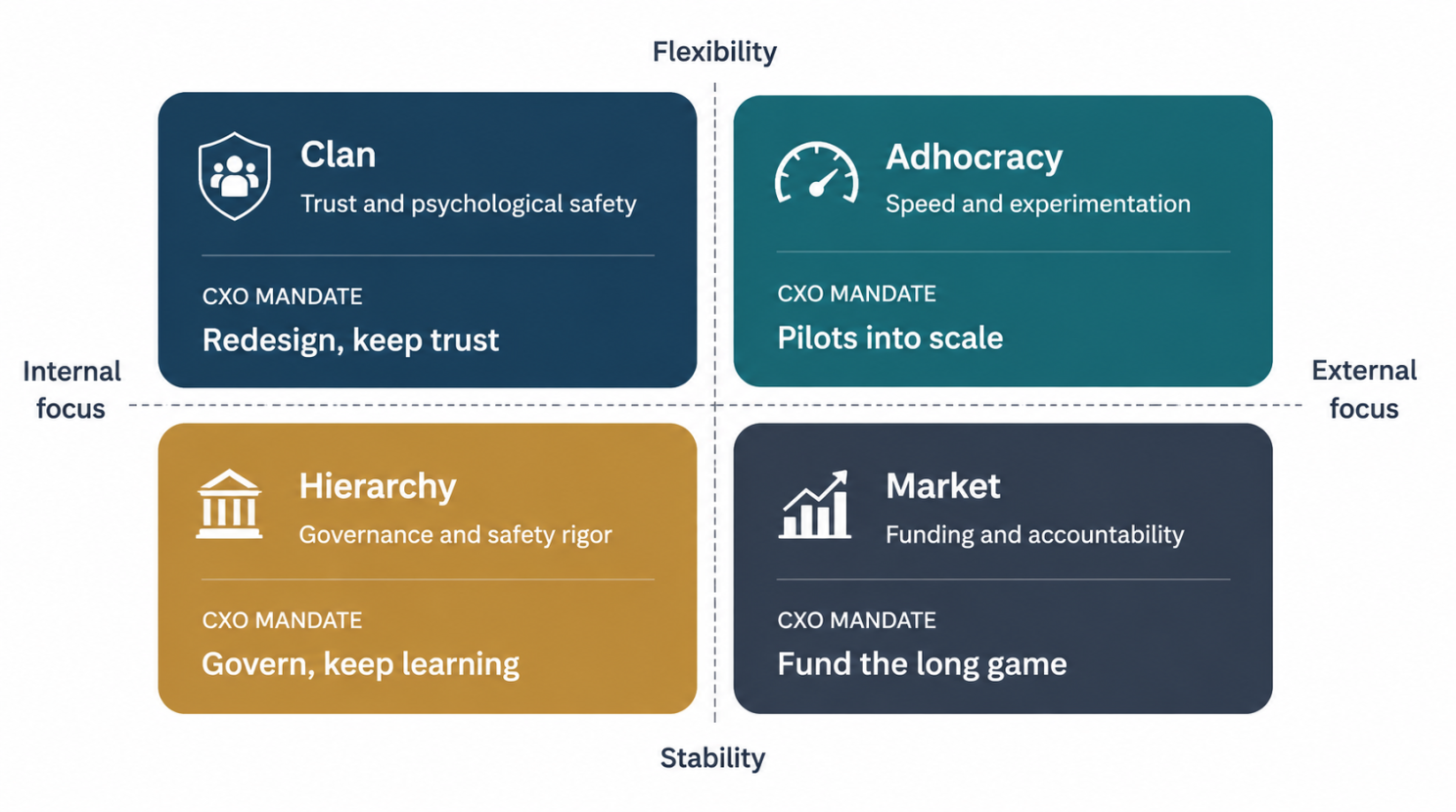
Strategy declares the destination, whereas the culture determines the speed and the casualties. The most widely used lens for this topography is the Competing Values Framework (CVF), which emerged from research by Quinn and Rohrbaugh (1983) into what makes organizations effective, and which Cameron and Quinn (2011) developed into the four familiar culture types: clan, adhocracy, market, and hierarchy, arrayed along two tensions, flexibility versus stability and internal versus external focus.
Empirical research consistently shows that culture is not decoration around an AI strategy; it is a determinant of outcomes. A global study of 2,197 managers by MIT Sloan Management Review and Boston Consulting Group (BCG) found that culture and AI shape each other in both directions: culture affects how AI deployments fare, and successful AI deployments measurably improve morale, collaboration, and collective learning (Ransbotham et al., 2021). The same research stream found that only about one in ten organizations achieves significant financial benefit from AI, and that organizations using AI to explore new ways of creating value were 2.7 times more likely to improve their competitiveness than those using it merely to optimize existing processes. Exploration versus optimization is a cultural posture before it is a portfolio choice. Each quadrant meets hybrid intelligence differently, and each brings a distinct gift and a distinct failure mode.
Adhocracy cultures (creative, externally focused, risk-tolerant) adopt the fastest. Research on digital transformation finds that a digitally oriented, innovation-friendly organizational culture is a decisive enabler of converting digital technology into firm performance (Martínez et al., 2020). The failure mode is pilot proliferation: dozens of experiments, no governance, no scale, and clinician whiplash.
Clan cultures (collaborative, internally focused, people-centered) supply what hybrid intelligence needs most: psychological safety, trust, and the willingness to learn alongside a machine. In healthcare specifically, collaborative cultures of this kind are consistently tied to quality improvement and safety outcomes (Mannion & Davies, 2018). The failure mode is protective inertia, in which loyalty to colleagues and existing roles becomes a resistance to redesigning them.
Market cultures (competitive, results-oriented) fund AI aggressively and demand measurable returns, which disciplines the portfolio. The failure mode is impatience with the learning curve that defines hybrid intelligence: when the system must improve over quarters, a culture that demands results this quarter starves the partnership before it matures, or worse, quietly removes the human to cut costs.
Hierarchy cultures (controlled, process-driven), common in healthcare, excel at exactly what immature AI programs lack: governance, standardization, auditability, and safety discipline. The failure mode is treating hybrid intelligence as a compliance object, where the machine is controlled so thoroughly that learning, the defining property of the system, is procedurally impossible.
✦ ✦✦ Dr. Kothapalli’s Insights: A final wrap of the article
Does the CVF Still Matter in the AI Era?
It is fair to ask whether a framework built in the early 1980s survives contact with a technology that rewrites how work is performed. My answer, after sitting with the academic research and practical experience with transformation, is yes, but its role changes.
The quadrants remain relevant because the framework was never about technology. It maps permanent tensions of organized human effort: flexibility against control, internal cohesion against external competition. AI does not abolish the tensions, but it intensifies them. An organization deploying autonomous agents needs more clarity about the trade-off between control and flexibility, not less. Culture remains the deepest layer of how an organization actually behaves; practitioner research on AI-powered organizations reaches the same conclusion, finding that the greatest barriers to scaling AI are cultural and organizational rather than technical (Fountaine et al., 2019). Leaders who ignore this find that culture eats their AI strategy as reliably as it ate every strategy before it.
What changes is that no single quadrant is sufficient any longer. Hybrid intelligence demands a deliberately ambidextrous culture: adhocracy’s experimentation to discover what the partnership can do, hierarchy’s discipline to govern models and protect patients, clan’s trust so that humans engage rather than resist, and market’s accountability so the program survives budget scrutiny. The MIT Sloan Management Review and Boston Consulting Group (BCG)‘s findings reveal that AI did not reward one culture type; it rewarded organizations capable of changing assumptions, measures, and behaviors as they learned (Ransbotham et al., 2021). In the AI era, the CVF matters less as a typology that tells you what you are, and more as a diagnostic that tells you which cultural muscles your hybrid intelligence strategy will strain first.
Healthcare digital transformation will not be decided by model benchmarks. It will be decided by whether leadership can see its own biases as clearly as it audits its algorithms, and whether it can read its culture as carefully as it reads its balance sheet. The organizations that succeed with hybrid intelligence will be those whose leaders strategize the partnership, name the invariants, govern their own cognition, and treat culture not as the soft side of transformation but as the operating system on which every model ultimately runs.
The framework historically described how humans relate to humans. The deeper shift with hybrid intelligence management adds a new cultural question the original authors never had to ask: how does this organization relate to its machine colleagues? Do we treat AI output with clan-like trust, hierarchical control, market skepticism, or adhocratic curiosity? Every organization is already implicitly answering that question. Henceforth, the strategic act is to answer it deliberately.
The quiet signals are already present in every organization: which pilots get celebrated, which dissent gets dismissed, which skills are silently atrophying. Leaders who listen for those whispers now will not need to explain the loud failures later.
References:
Abdelwanis, M., Alarafati, H. K., Tammam, M. M. S., & Simsekler, M. C. E. (2024). Exploring the risks of automation bias in healthcare artificial intelligence applications: A Bowtie analysis. Journal of Safety Science and Resilience, 5(4), 460–469. https://doi.org/10.1016/j.jnlssr.2024.06.001
Acciarini, C., Brunetta, F., & Boccardelli, P. (2021). Cognitive biases and decision-making strategies in times of change: A systematic literature review. Management Decision, 59(3), 638–652. https://doi.org/10.1108/MD-07-2019-1006
Akata, Z., Balliet, D., de Rijke, M., Dignum, F., Dignum, V., Eiben, G., Fokkens, A., Grossi, D., Hindriks, K., Hoos, H., Hung, H., Jonker, C., Monz, C., Neerincx, M., Oliehoek, F., Prakken, H., Schlobach, S., van der Gaag, L., van Harmelen, F., . . . Welling, M. (2020). A research agenda for hybrid intelligence: Augmenting human intellect with collaborative, adaptive, responsible, and explainable artificial intelligence. Computer, 53(8), 18–28. https://doi.org/10.1109/MC.2020.2996587
Burton, J. W., Stein, M. K., & Jensen, T. B. (2020). A systematic review of algorithm aversion in augmented decision making. Journal of Behavioral Decision Making, 33(2), 220–239. https://doi.org/10.1002/bdm.2155
Cameron, K. S., & Quinn, R. E. (2011). Diagnosing and changing organizational culture: Based on the competing values framework (3rd ed.). Jossey-Bass.
Dellermann, D., Ebel, P., Söllner, M., & Leimeister, J. M. (2019). Hybrid intelligence. Business & Information Systems Engineering, 61(5), 637–643. https://doi.org/10.1007/s12599-019-00595-2
Fountaine, T., McCarthy, B., & Saleh, T. (2019). Building the AI-powered organization. Harvard Business Review, 97(4), 62–73. https://hbsp.harvard.edu/product/R1904C-PDF-ENG
Glikson, E., & Woolley, A. W. (2020). Human trust in artificial intelligence: Review of empirical research. Academy of Management Annals, 14(2), 627–660. https://doi.org/10.5465/annals.2018.0057
Kahneman, D. (2011). Thinking, fast and slow. Farrar, Straus and Giroux.
Martínez-Caro, E., Cegarra-Navarro, J. G., & Alfonso-Ruiz, F. J. (2020). Digital technologies and firm performance: The role of digital organizational culture. Technological Forecasting and Social Change, 154, 119962. https://doi.org/10.1016/j.techfore.2020.119962
Mannion, R., & Davies, H. (2018). Understanding organizational culture for healthcare quality improvement. BMJ, 363, k4907. https://doi.org/10.1136/bmj.k4907
Martínez-Caro, E., Cegarra-Navarro, J. G., & Alfonso-Ruiz, F. J. (2020). Digital technologies and firm performance: The role of digital organizational culture. Technological Forecasting and Social Change, 154, 119962. https://doi.org/10.1016/j.techfore.2020.119962
Ransbotham, S., Candelon, F., Kiron, D., LaFountain, B., & Khodabandeh, S. (2021). The cultural benefits of artificial intelligence in the enterprise. MIT Sloan Management Review and Boston Consulting Group. https://sloanreview.mit.edu/projects/the-cultural-benefits-of-artificial-intelligence-in-the-enterprise/
Samuelson, W., & Zeckhauser, R. (1988). Status quo bias in decision-making. Journal of Risk and Uncertainty, 1(1), 7–59. https://doi.org/10.1007/BF00055564
#AIBiasInHealthcare #HealthEquity #ResponsibleAI #MedicalAI #AlgorithmicFairness #AI Ethics #CVF #Organization Culture
Thank you for reading. Biased AI doesn’t announce itself, but it surfaces in missed diagnoses, skewed risk scores, and care gaps that fall hardest on those already underserved. The organizations that lead on data modernization with built-in equity frameworks will set the standard for a decade of responsible healthcare AI.
Awareness is where transformation begins; action is where it earns trust. If your organization is ready to move from talking about responsible AI to designing systems that are transparent, auditable, and equitable by architecture rather than by aspiration, I would welcome the conversation. This is the work I do: helping leadership teams architect the roadmap, govern the journey, and decide what must not change as the technology accelerates. The patients, clinicians, and communities your organization serves deserve nothing less. Let’s build it deliberately, together.
Book a convenient time directly in my calendar using my Zoom scheduler here: https://scheduler.zoom.us/dr-karuna-kothapalli
Otherwise, DM me or contact me at karunak@nexushealthinformatics.com