Behavioral health (BH) organizations possess some of the richest and most sensitive clinical, social, and behavioral datasets in healthcare. Yet regulatory complexity, stigma, fragmented technology environments, and inconsistent governance have limited the industry’s ability to activate these assets for care improvement, population health, and AI-driven innovation.
1.0 The Data Paradox in BH Data
BH generates longitudinal patient narratives, social determinants information, crisis interventions, care management notes, and treatment histories. Despite this richness, organizations often struggle to create a unified view of patients and populations. Some of the prevailing unique data strategy challenges are as follows:
• HIPAA and 42 CFR Part 2 compliance complexity
• Stigma-driven restrictions and organizational risk aversion
• Fragmented EHR and care coordination ecosystems
• Limited interoperability and data sharing
• Inconsistent master data management
• Underdeveloped governance frameworks
However, the BH sector is entering a pivotal period in which demand for integrated, data-driven care is accelerating faster than the industry’s ability to govern and exchange information. Recent regulatory changes have begun aligning HIPAA and 42 CFR Part 2 requirements to improve care coordination, including expanded consent provisions that allow broader use and disclosure of substance use disorder records for treatment, payment, and healthcare operations (CMS, 2024). Nonetheless, BH organizations continue to face significant compliance complexity as they balance privacy protection with interoperability objectives. At the same time, stigma surrounding mental health and substance use disorders contributes to organizational risk aversion, limiting data sharing and reinforcing siloed information practices. Federal agencies have recognized these challenges and recently launched nationwide behavioral health interoperability pilots focused on privacy, consent management, and secure data exchange to address long-standing barriers to coordinated care.
Despite substantial progress in healthcare interoperability, behavioral health continues to be characterized by fragmented EHR ecosystems, inconsistent master data management practices, and underdeveloped governance frameworks. Many mental health and substance use treatment organizations were excluded from earlier federal EHR incentive programs, resulting in lower levels of technology maturity and persistent interoperability gaps compared with the broader healthcare sector. As AI adoption increases, these deficiencies create substantial risks related to data quality, algorithmic bias, and governance oversight (Kuenzi & Greenbaum, 2020). Current industry trends are therefore shifting toward FHIR-enabled interoperability, consent-driven data sharing, enterprise data governance, and responsible AI frameworks that emphasize transparency, privacy, and trust. Organizations that establish robust governance structures, standardized data management practices, and interoperable data architectures will be best positioned to unlock the value of behavioral health data while maintaining compliance and public trust in an increasingly AI-enabled healthcare environment.
✦ ✦✦ What Dr. Kothapalli Advocates:
As the founder of Nexus Health Informatics (NHI), the advocacy promotes that the future of behavioral health will not be determined by who possesses the most data, but by who can govern, share, and use that data responsibly. Effective AI adoption begins with trust, transparency, ethical governance, and interoperable data foundations, rather than relying solely on technology. Through a combination of AI governance, interoperability strategy, bias mitigation, and the Whisper-Responsive Leadership Signal Framework™, organizations can identify hidden risks, address systemic inequities, and create a trusted framework for innovation. The opportunity for behavioral health leaders is to move beyond compliance-focused data management toward a strategic model where privacy, ethics, and innovation coexist, enabling data to become a catalyst for better outcomes, stronger patient trust, and more equitable care.
2.0 Biases That Impact BH Data
BH has historically prioritized privacy over interoperability, resulting in isolated systems and limited data sharing. Funding constraints and diverse provider ecosystems further contributed to data fragmentation. Before BH organizations can fully realize the promise of advanced analytics and artificial intelligence, they must first understand and address the biases embedded within their data ecosystems. As such, BH data is uniquely vulnerable to bias because it is shaped not only by clinical observations but also by social stigma, access barriers, provider documentation practices, regulatory constraints, and patient willingness to disclose sensitive information. These factors can create incomplete, inconsistent, or unrepresentative datasets that influence clinical decision-making, population health analyses, and AI model performance. If left unaddressed, such biases can perpetuate disparities, reinforce inequities, and undermine trust in both healthcare delivery and emerging technologies. The table below lists some of the biases and ethical risks that impact BH data:
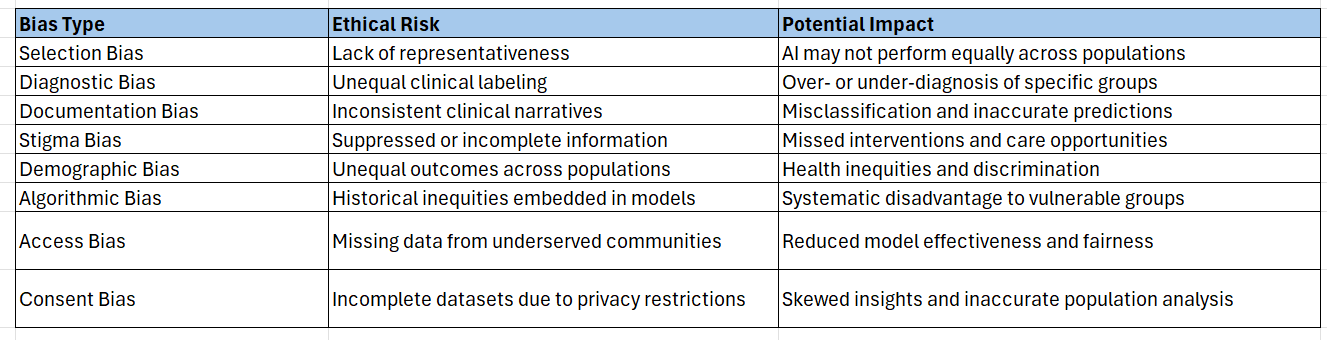
The challenge is particularly significant in BH because data often reflect complex human experiences rather than discrete clinical events. Selection bias, diagnostic bias, documentation bias, stigma bias, access bias, and algorithmic bias can all distort the accuracy and fairness of insights derived from behavioral health data. As organizations increasingly adopt AI-driven tools to improve care coordination, risk prediction, and treatment planning, establishing governance processes to identify, monitor, and mitigate these biases becomes essential. Addressing bias is not simply a technical requirement; it is a strategic and ethical imperative that ensures data-driven innovations support equitable, trustworthy, and patient-centered behavioral healthcare.
✦ ✦✦ What Dr. Kothapalli Advocates:
Behavioral health organizations do not have a data problem. They have a trust problem, a governance problem, and an ethics problem that manifests through data. The AI Maturity Model for Behavioral Healthshould be architected in a structured pathway for organizations to evolve from basic compliance-focused AI activities toward a fully integrated, trust-centered AI ecosystem (Fountaine et al., 2019). At the foundational level, most BH organizations are primarily reactive, focusing on regulatory compliance, privacy requirements, and limited governance oversight. As maturity increases, organizations should establish formal data governance programs, implement AI risk management practices, and develop mechanisms to evaluate fairness, transparency, and model performance. More advanced organizations move beyond technical implementation to incorporate continuous monitoring, independent audits, explainable AI capabilities, and stakeholder engagement.
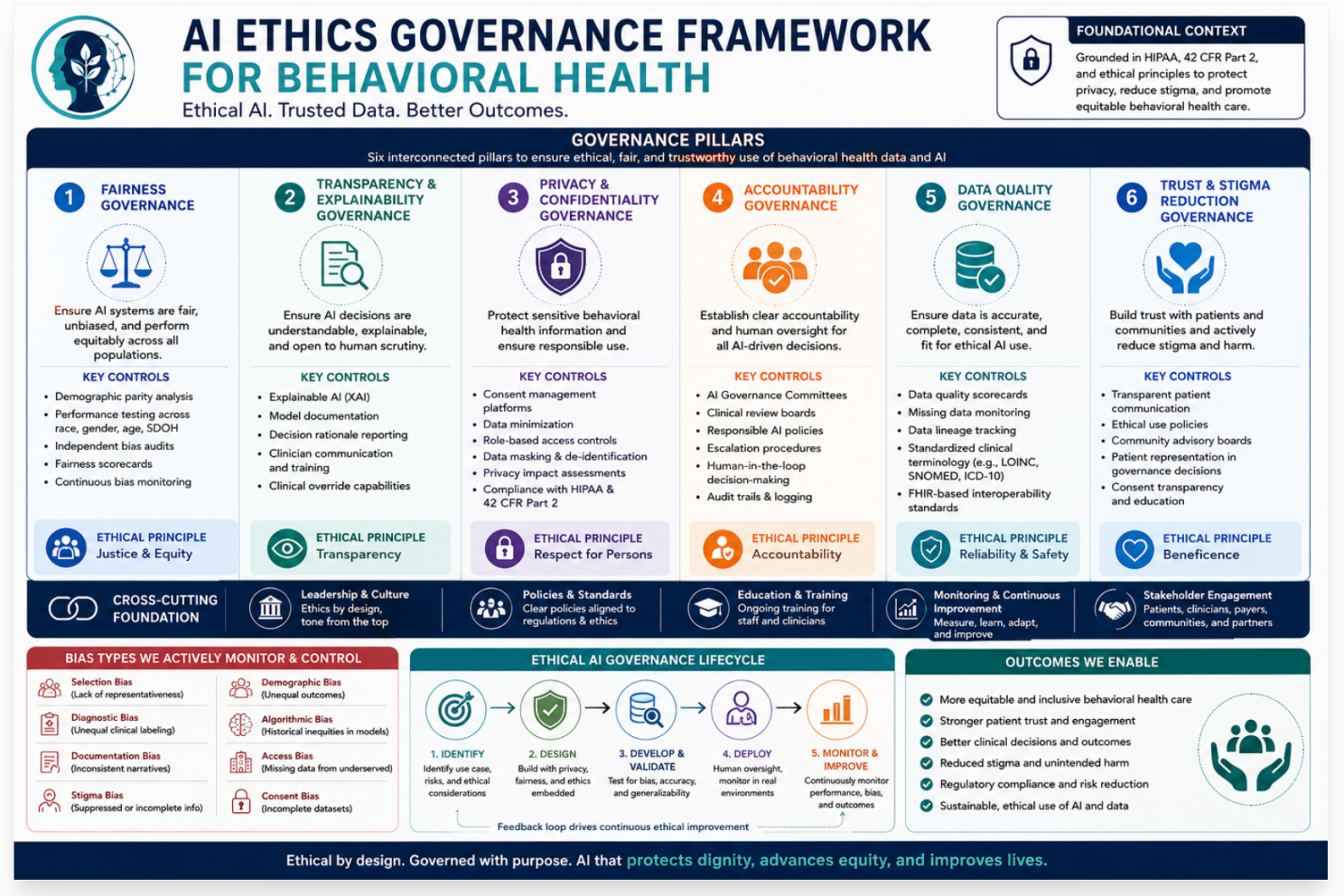
A conceptualized governance framework is illustrated in the above image. At the highest level of maturity, responsible AI principles are embedded in organizational culture, enabling behavioral health providers to leverage data and AI ethically while maintaining patient trust, reducing bias, and supporting equitable care outcomes. The greatest ethical risk in behavioral health AI is not the bias we detect, but the bias we fail to notice. Many of the most consequential inequities begin as weak signals hidden within data collection practices, documentation habits, access barriers, and historical treatment patterns. Ethical AI governance, therefore, becomes an exercise in signal detection, identifying emerging inequities, questioning assumptions, and ensuring that technology serves human dignity rather than simply optimizing efficiency.
Check out the White Paper on the Whisper-Responsive Leadership Signal Framework™, which encourages organizations to listen for these subtle signals before they become systemic harms.
At Nexus Health Informatics, we help BH organizations transform sensitive data into trusted intelligence through AI governance, interoperability, and responsible data strategy. Because the future of behavioral health will not be determined by who has the most data, but by who can use it responsibly, ethically, and effectively.
Article Wrap-up
BH stands at a defining crossroads. The sector possesses an extraordinary wealth of clinical, behavioral, and social data that can transform care delivery, improve outcomes, and enable more personalized interventions. Yet the true challenge is not collecting more data; it is creating the governance, trust, interoperability, and ethical foundations necessary to use that data responsibly. As organizations pursue AI-driven innovation, success will depend on their ability to address longstanding biases, strengthen data stewardship, and establish transparent frameworks that balance privacy with progress. The future of behavioral health will not be shaped by technology alone, but by the leadership decisions that determine how data is governed, shared, and trusted.
For healthcare leaders, the opportunity extends beyond compliance and digital modernization. It is an opportunity to reimagine behavioral health through a lens of responsible innovation, where AI augments human judgment, governance protects patient dignity, and data becomes a catalyst for equitable care. The organizations that emerge as leaders will be those that recognize the subtle signals hidden within fragmented systems, governance gaps, and data biases before they become systemic barriers. By embracing ethical AI, interoperable ecosystems, and trust-centered leadership, behavioral health organizations can transform the data paradox into a strategic advantage, unlocking insights that improve lives while preserving the confidence of the patients and communities they serve.
If you found this analysis valuable, follow my continuing series on Healthcare AI Ethics and subscribe to the CMS ePriorAuth Interop newsletter.
Check out Series #1 of the Healthcare AI Ethics: https://www.linkedin.com/pulse/healthcare-ai-ethics-weekly-series-1-dr-karuna-kothapalli-4dm4c/
Check out Series #2 of the Healthcare AI Ethics: https://www.linkedin.com/pulse/healthcare-ai-ethics-weekly-series-2-dr-karuna-kothapalli-jykmc/
References:
Centers for Medicare & Medicaid Services. (2024). CMS Interoperability and prior authorization final rule (CMS-0057-F). U.S. Department of Health and Human Services. https://www.cms.gov/priorities/key-initiatives/burden-reduction/interoperability
Fountaine, T., McCarthy, B., & Saleh, T. (2019). Building the AI-powered organization. Harvard Business Review, 97(4), 62–73. https://hbsp.harvard.edu/product/R1904C-PDF-ENG
Kuenzi, M., Mayer, D. M., & Greenbaum, R. L. (2020). Creating an ethical organizational environment: The relationship between ethical leadership, ethical organizational climate, and unethical behavior. Personnel Psychology, 73(1), 43–71. https://doi.org/10.1111/peps.12356
Thank you for reading. The leaders who move now will define the standard of care for the next decade. If modernizing your organization’s approach to healthcare innovation is a priority, I’d welcome the opportunity to be part of that journey, architecting the roadmap and structuring the implementation.
Book a convenient time directly in my calendar using my Zoom scheduler here: https://scheduler.zoom.us/dr-karuna-kothapalli
Otherwise, DM me or contact me at karunak@nexushealthinformatics.com